
The challenge
A claim file at HDG is a motley collection of documents: the intro email with the claim notification, the Bill of Lading, the commercial invoice, the packing list, a screenshot of the container tracking, the temperature recorder data, the survey findings, photos, price lists and sometimes a phytosanitary certificate or a claim letter from the carrier. About sixty percent of the information comes from email, forty percent from the survey itself. No two documents carry the same case reference.
The surveyor copied all that data field by field into HDG's fixed Word template and completed it with standard texts and a conclusion. That took two to two and a half hours per report on average. A second surveyor then reviewed the report, and had to go through every source file again because nothing recorded where a value had come from. At around 1,500 reports a year, that adds up to well over 3,000 hours of manual work.
The volume is also highly seasonal. Quiet months see ten to twelve reports, peak months dozens a week, and the backlog could grow to two or three hundred reports. All this while claim notifications and reports are bound to strict deadlines per mode of transport. HDG wanted to handle that peak volume without growing the team in step, and without compromising the reliability of a report that is used in claims and recovery proceedings.
Our approach
- 01
The domain first, then the software
We started with the survey department's reference manual, the report template and 23 real example files. From those we distilled the field schema: which value comes from which document, when which standard text applies and where the surveyor always makes the call. We captured that analysis in a functional PRD that was revised in three rounds with HDG before a single line of code was written.
- 02
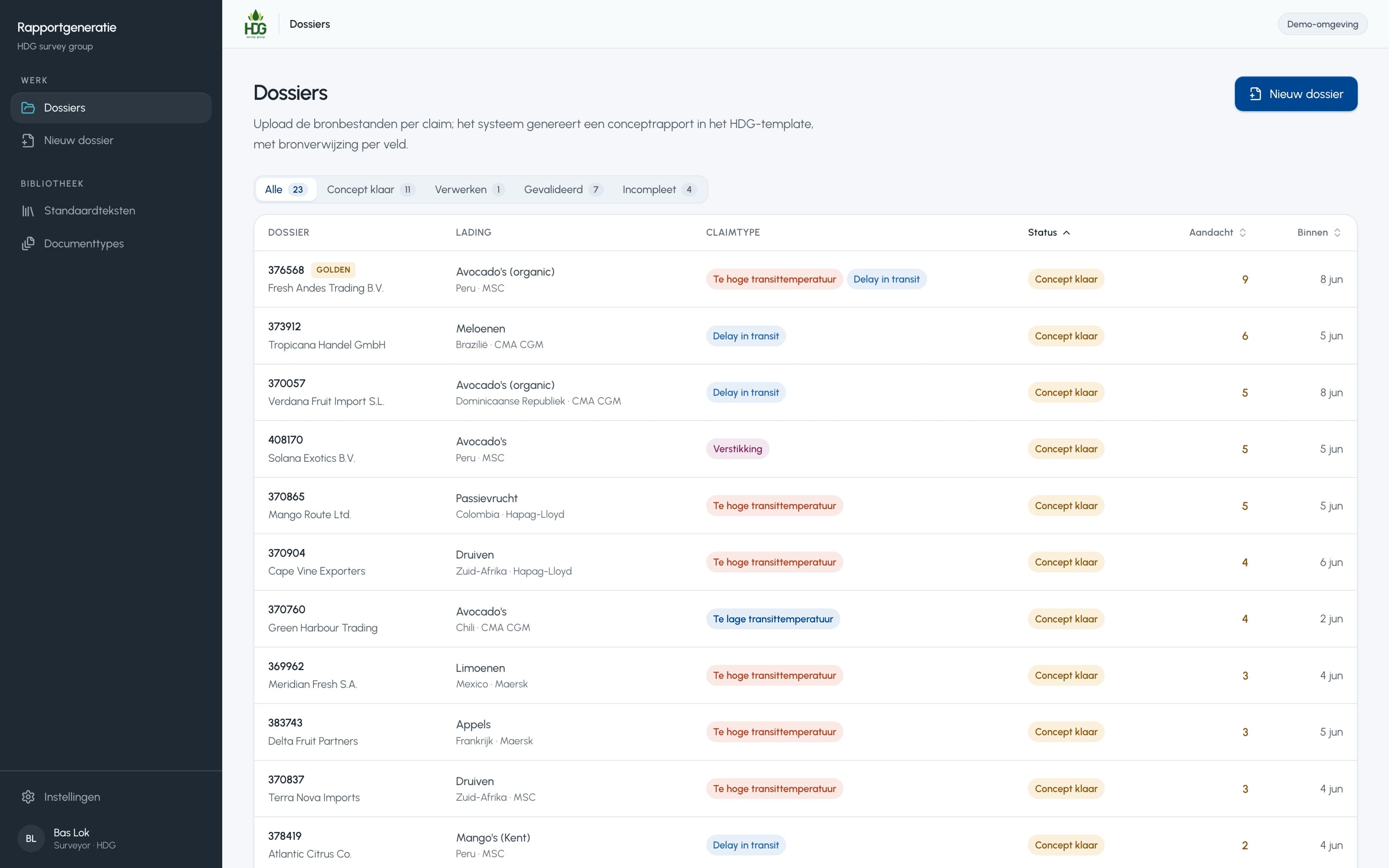
Upload, recognise, extract
The surveyor creates a case and uploads the source files. The application recognises each document type, shows which expected documents are still missing and extracts the report fields. All documents go to a multimodal AI model as images, so born-digital PDFs, scans, screenshots and handwritten forms all follow the same route. Spreadsheets such as the transit events file are parsed deterministically in code.
- 03
Every field traceable to its source
For every field, the review screen shows the document, the page and the literal quote the value was taken from, with a status: found, to be checked or not found. That status is not derived from a model confidence score, but mechanically from quote verification, validation rules and flagging of conflicting sources. Uncertain or missing information never slips into the report unseen.
- 04
A Word draft in HDG's own template
With one click the application generates the draft report in the exact HDG template, including the right standard texts based on commodity, claim type and container condition, plus a first draft of the conclusion. Places for photos, tables and the damage calculation are marked; the surveyor fills those in deliberately by hand. If the surveyor corrects a field, the report regenerates with the correction applied.
- 05
From kick-off to hypercare in three months
Kick-off in Ridderkerk in early June, weekly alignment per milestone and an explicit go/no-go at the end of every phase. The application runs on Azure Container Apps in Bonsai's tenant, with sign-in through Microsoft Entra ID and AI processing in an EU region. Since going live in August, the surveyors have been testing with real cases and we process their feedback in short releases.
The result
The target agreed with HDG: drafting time per report down from an average of 2.25 hours to around 0.75 hours, a reduction of two thirds. At 1,500 reports a year that comes to well over 2,000 hours flowing back into the inspection work itself. Just as important is the effect on the second reader, who validates a report through the source references instead of going through every document again.
The application is live and in its hypercare phase. We will share real-world figures once the first peak season has been processed. The report generation is also a built-in part of the new inspection platform we are building with HDG as the successor to QC4U.