The challenge
Consumer complaints came in by email and through the contact form on jan.eu. Each one was read by hand, judged for severity and type, and answered with a reply that was then printed and sent by post. It took a lot of time per complaint, was error-prone and gave no real overview of what was coming in.
Nobody could see which complaints pointed at the same batch number, whether a customer had already been compensated, or whether a pattern was building that signalled a quality problem in production. And foreign objects or allergen complaints had no standard way of being handled.
Our approach
- 01
Automatic intake via email and contact form
Incoming complaints are pulled in automatically from the mailbox and the jan.eu contact form, grouped per customer into cases and made ready without anyone sorting them by hand.
- 02
AI analysis: type, urgency, sentiment and fraud
The AI sorts each complaint by type (product quality, packaging, shelf life, allergens, foreign object, other), urgency (low through to critical), sentiment (positive through to angry) and fraud signal (none, suspicious, possible fraud, spam). Allergen complaints are flagged as critical automatically.
- 03
Tailored draft reply
Working from templates and the content of the complaint, the system drafts a personalised reply: the right gift-voucher amount (5 or 10 euro), a return request where there's a foreign object, and a warning if compensation has already gone out earlier in the same case.
- 04
Staff check, the system sends
A member of staff reads the draft, tweaks it if needed and confirms it. Once it's approved, the reply goes out digitally, with the printing and the post left behind for good.
The result
The whole manual print-and-post routine is gone. Complaints arrive automatically, get analysed in seconds and land as ready drafts. A member of staff checks and sends, with no re-typing and no printing.
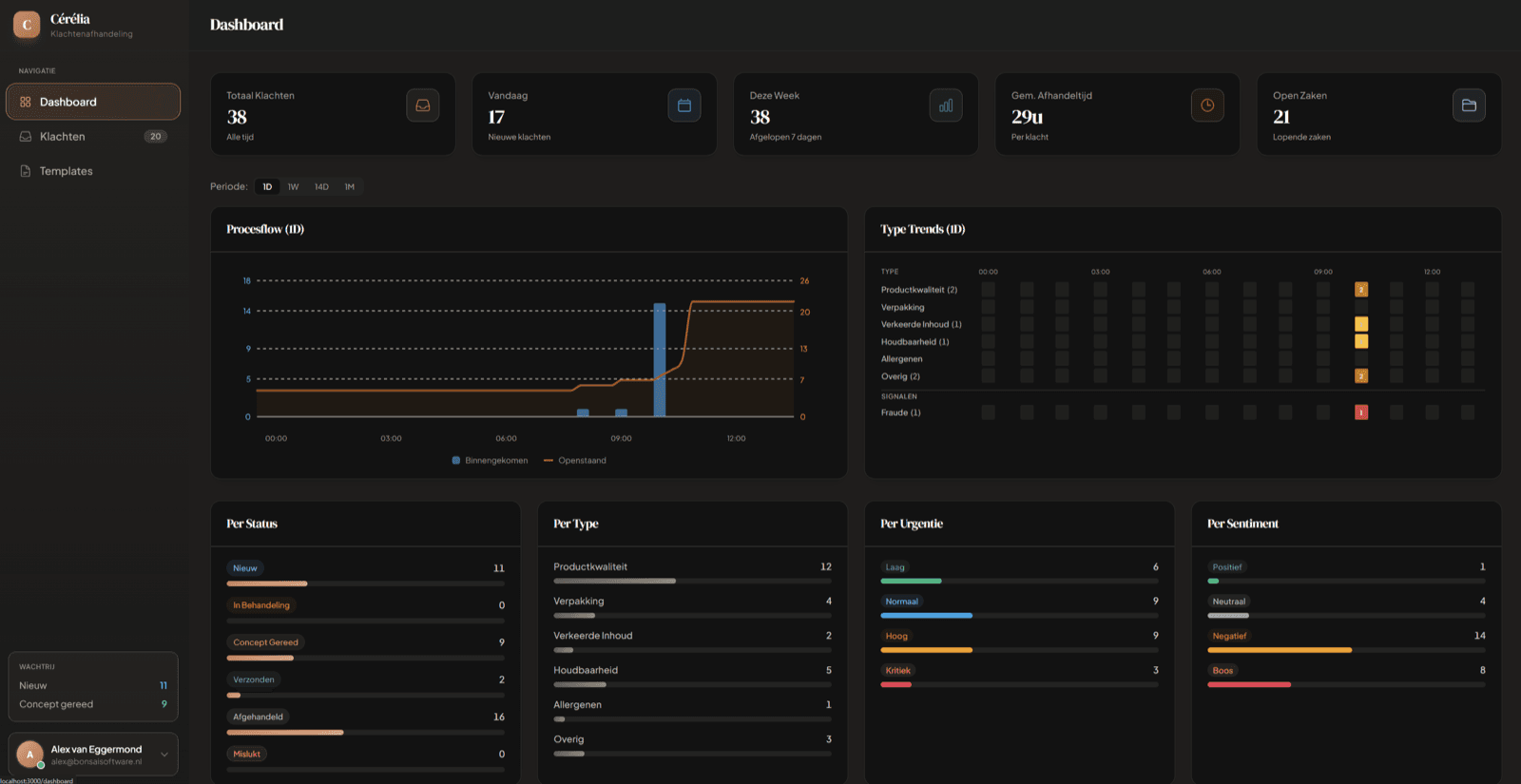
For the first time, the dashboard gives a real overview: which complaint types peak on which day, which batch numbers turn up across several complaints, and what the average handling time is. Patterns that used to stay hidden now show up at a glance.